**** WE ARE CURRENTLY RUNNING APPROXIMATELY 2 TO 3 WEEKS OUT FOR PROCESSING AND PACKING **PLEASE REMEMBER THAT SHIPPING TIMES YOU ARE QUOTED AT CHECK OUT ARE TRANSIT TIMES ONLY (how long it should take to get to you once the carrier has picked up your package), THIS DOES NOT INCLUDE PROCESSING AND PACKAGING TIME**. As always we thank you for your business and your patience. 9/14/26 Dismiss
Skip to content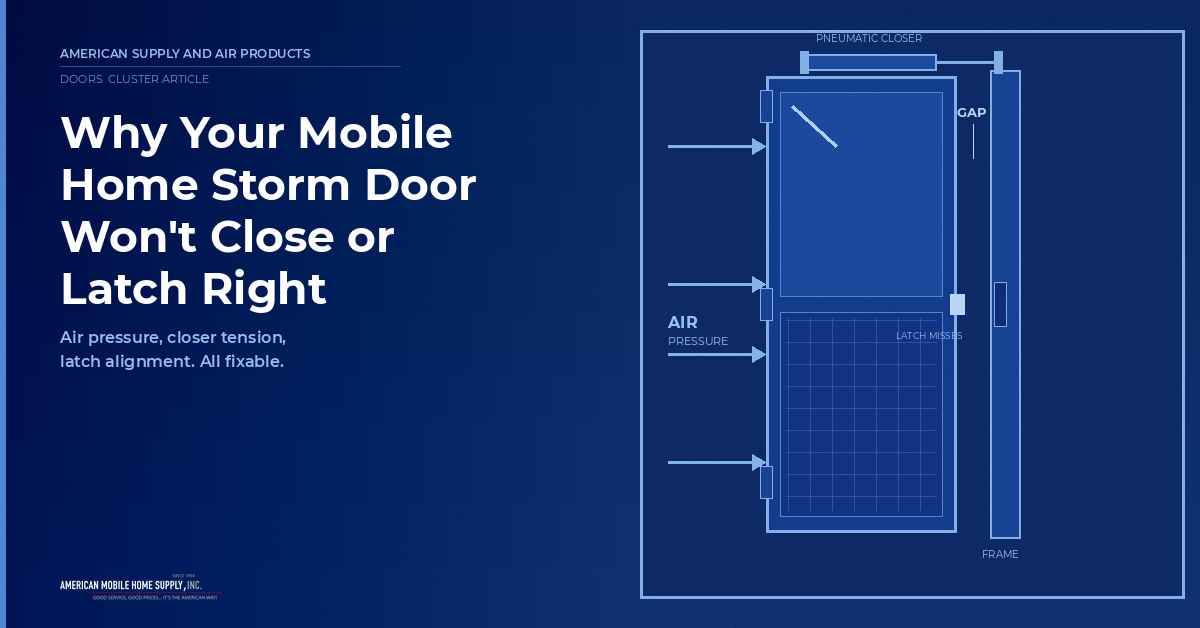
Air is the suspect almost nobody checks. When a mobile home storm door won't close, the mind goes straight to broken hardware, and yet in a tightly sealed home, the thing holding the door open an inch from its frame is often a cushion of trapped air with nowhere to go. Mechanical failures happen too, and you can fix all of them right at the entryway, but your troubleshooting will go much faster if you check the simplest causes first.
This guide gives you a clear, step-by-step checklist to isolate the issue. We look at four common problems, starting with a free air test you can run in ten seconds and ending with simple screwdriver adjustments to get your entryway locking perfectly again.
The physics behind a storm door air pressure problem are incredibly simple. Your outer storm door and your main exterior door share a very shallow pocket of air between them. At the same time, the inside of your home holds a much larger volume of air right behind the main entryway.
If you swing the main door shut quickly while all the windows are closed, that displaced air has to find an exit path. The easiest way out is through the outer entryway, which shoves the storm panel outward at the exact moment its mechanical closer is trying to pull it shut.
The same pressure works in reverse. With the glass panel up and the seals tight, pulling the storm door shut compresses that pocket of air, and it pushes back like a pillow, stopping the door just short of the latch.
Run this free test to verify the issue:
Why this shows up more in manufactured homes: A smaller interior air volume changes pressure faster than a large one when a door swings. The same door-closing motion that a big site-built house absorbs without effect produces a noticeable push in a compact, well-sealed manufactured home.
The easiest long-term fix is simply dropping your self-storing glass window down a quarter of an inch during the winter to give the trapped air a fast escape route.
The pneumatic cylinder running along the top or bottom of your door frame does two jobs: it pulls the door shut, and it controls how fast it closes. Over time, both of those stop working the way they should. The internal rubber seals wear down, and seasonal temperature changes affect the air pressure inside the metal cylinder, throwing off the timing and force.
The mechanical warning signs sort themselves into very clear categories. A door panel that drifts closed slowly but stops an inch short of the latch has a cylinder that is set too weak. A door that slams hard enough to shake the wall is set too firm. A door that moves at a normal speed but doesn't fully close the latch just needs a minor tweak.
Follow these steps to complete a quick storm door closer adjustment:
Quarter turns only. A quarter turn changes closing behavior more than it seems like it should. Adjust, close the door twice, then decide whether it needs another quarter. Full-turn adjustments overshoot in both directions and turn a two-minute job into twenty.
A closer that no longer responds to any adjustment, or leaks oil along the cylinder, has finished its service life. Replacement closers install with the same bracket pattern in most cases, and swapping one takes about fifteen minutes.
A storm door won't latch properly when the spring-loaded handle tongue and the metal strike plate on the wall no longer meet at the same height. On a mobile home wall frame, this alignment drift almost always happens on the hinge side rather than the handle side. The door panel settles a few millimeters on its vertical hinge rail, causing the latch tongue to strike the solid metal border just below the opening it is supposed to enter.
You can easily diagnose this by looking closely at the face of the strike plate for shiny scratch marks. Bright, raw metal marks above the center slot mean your door has shifted upward. Scrape marks below the slot mean the door panel has dropped.
Most replacement strike plates are built with elongated screw slots for this exact reason. Simply loosen the two wall screws, slide the metal plate directly toward the shiny scrape marks, and retighten the hardware. This simple change restores perfect alignment without forcing you to alter the handle assembly. If the plate reaches the absolute end of its slot adjustment travel and the tongue still misses, stop adjusting the plate and look at your vertical mounting rail.
Storm doors hang from a continuous vertical aluminum rail screwed into the outer wood door casing, and every opening cycle puts heavy leverage on those fasteners. Mobile home door jambs are inherently thinner than standard residential house framing, meaning the mounting screws have much less timber to bite into. Over time, the screws work loose, the metal rail tilts away from the wall, and the entire door drops out of square.
Tightening the visible casing screws is your first step. If a screw spins freely without gripping anything, the wood hole inside the wall is completely stripped. Swapping it out for a slightly longer wood screw of the exact same head style will allow you to grab fresh, solid timber hidden behind the worn-out opening.
Always check the vertical rail with a level after tightening your hardware. If the rail is reinstalled crooked, it will reproduce every single dragging and latching symptom instantly. A door rail that keeps loosening up no matter how often you snug the fasteners points to a deeper wall frame issue. When your actual wall framing shifts out of square, protect your investment by checking your wall frame dimensions to see how the opening, jamb depths, and doors tie together before buying replacement parts.
Standard self-storing storm door issues follow a very specific mechanical pattern because the door frame carries both the glass window and the mesh screen panels inside its own body. The physical position of those heavy internal panels directly alters how the door panel swings:
None of these troubleshooting adjustments change your actual swing orientation, which is locked in when the door is manufactured. If your frame is warped beyond repair and you need to buy a replacement unit, confirm whether you need an outswing vs inswing mobile home door. Then hang carefully to ensure your new storm door hinges on the same side as your main exterior door.
Basic hardware adjustments can fix minor alignment issues, but they cannot fix a bent aluminum frame corner, a cracked vertical hinge rail, or an outer metal skin that is separating from its wood core. A storm door with true structural damage will eat every adjustment you try to make and drift back out of alignment within a couple of weeks because the core geometry of the unit is completely ruined.
When repair time is no longer worth the effort, choosing a replacement unit built for specialized mobile home wall openings is the best path forward. Our dedicated storm doors catalog features units sized specifically for mobile home entries. If your entire entryway is failing, browsing our full mobile home doors range allows you to update both the inner utility door and the outer shield together as a single system.
Tell us what the door does when you close it, and where the scrape marks are. That is usually enough for us to name the cause over the phone. Supplying manufactured home parts since 1994.
Call 1-800-368-6208 | Mon-Fri 8am-5pm | Sat 9am-1pm
Keep reading on the specific problem you are dealing with:

Powered by WooCommerce Checkout On Popup Plugin from WPSuperiors
Powered by WooCommerce Checkout On Popup Plugin from WPSuperiors


