
**** WE ARE CURRENTLY RUNNING APPROXIMATELY 2 TO 3 WEEKS OUT FOR PROCESSING AND PACKING **PLEASE REMEMBER THAT SHIPPING TIMES YOU ARE QUOTED AT CHECK OUT ARE TRANSIT TIMES ONLY (how long it should take to get to you once the carrier has picked up your package), THIS DOES NOT INCLUDE PROCESSING AND PACKAGING TIME**. As always we thank you for your business and your patience. 10/5/26 Dismiss
Skip to content$78.25 $78.25
$14.39 $14.39
5 in stock
$12.22 $12.22
8 in stock
$0.85 $0.85
$18.54 $18.54
Out of stock
$11.45 $11.45
Out of stock
$69.39 $69.39
6 in stock
$16.09 $16.09
Out of stock
$12.63 $12.63
Out of stock
$12.87 $12.87
Out of stock
$13.23 $13.23
Out of stock
$12.31 $12.31
Out of stock
$12.86 $12.86
Out of stock
$16.51 $16.51
Out of stock
$32.91 $32.91
Out of stock
$18.35 $18.35
Out of stock

Mobile home siding is made for a lighter wall system than the siding used on a typical site-built house. The wall panels are lighter and need to handle some movement as the home settles or is transported. That is why siding made specifically for mobile homes is designed differently from standard residential siding.

The siding is only part of the job. Trim around mobile home windows and doors, corners and the roofline helps finish the edges and cover the gaps around the panels.

You do not always need to replace all the siding when only part of the wall is damaged. Individual panels can be replaced as needed, making it possible to repair a section without removing siding from the entire home.

Full-length panels travel by LTL freight and arrive curbside. We also cut vinyl for a small fee so it ships UPS, and we quote that by phone. Or collect from any of our seven North Carolina locations in Fayetteville, Erwin, Sanford, Goldsboro, Winston-Salem and Ramseur.
Walk the wall with a tape before you order, and confirm these four things.
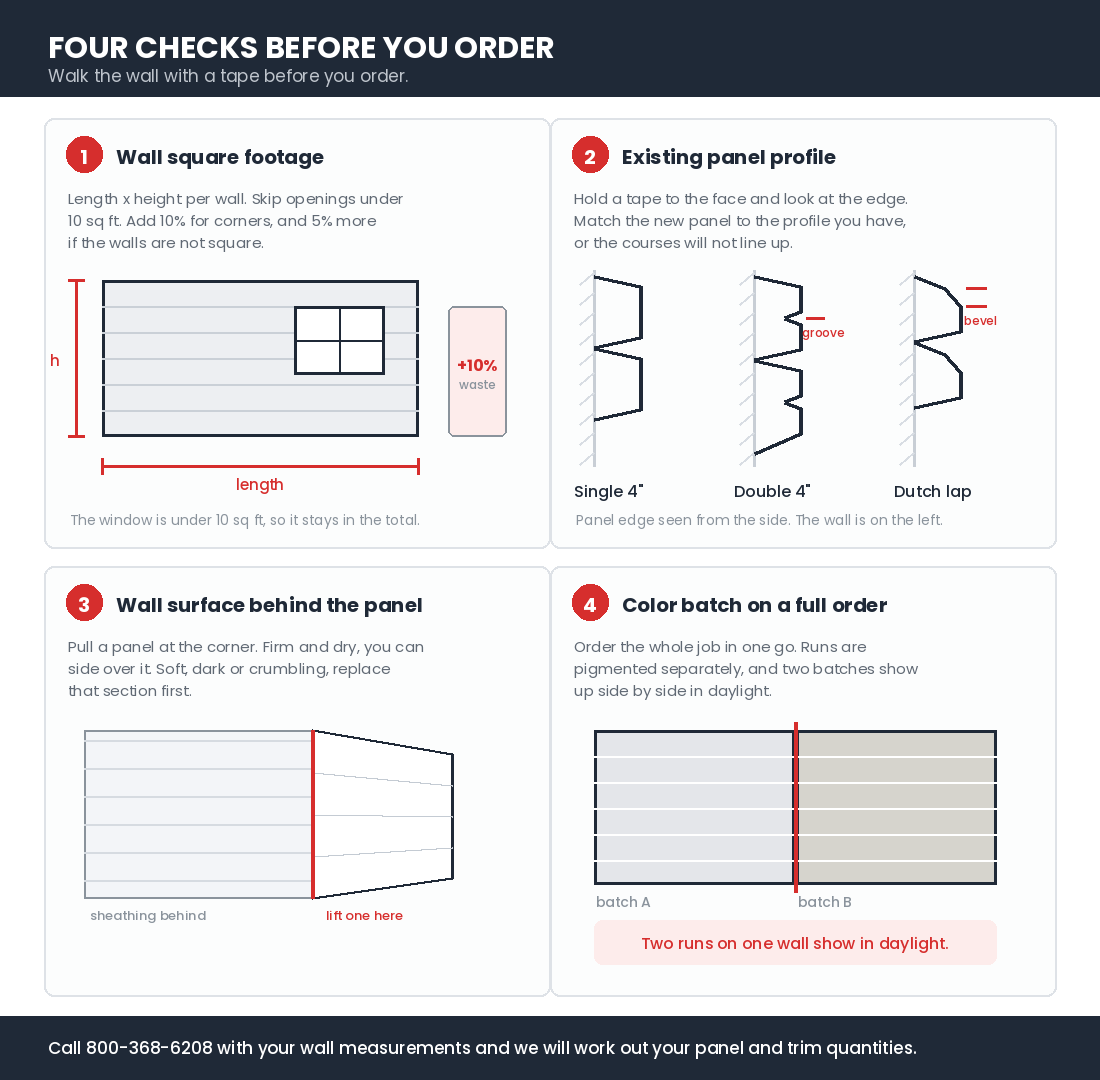
Measure each wall by multiplying its length by its height, then add the totals together. You can leave out openings smaller than 10 square feet, as there usually isn't enough leftover material to reuse. Add about 10% for corner waste, plus another 5% if the walls aren't perfectly square.
Hold a tape measure against the face of the panel to check the profile. Single 4-inch siding has one flat course, while double 4-inch has two courses with a groove between them. Dutch lap has a beveled edge that creates a shadow line along each course. Match the new siding to the existing profile so the courses line up properly.
Pull back a panel at the corner and check the sheathing underneath. If it is firm and dry, you can install the new siding over it. If the board is soft, dark or crumbling, replace the damaged section first so the new siding has a solid surface to fasten to.
Order the whole job at once. The factory pigments each production run separately, and slight tonal differences only show when two batches sit on the same wall in daylight. A top-up costs you a second freight charge, and we cannot take back cut-to-size panels. Check our shipping policy and returns and refunds policy first.
Start at the bottom and work your way up. Use a zip tool to unlock the bottom edge, remove the fasteners, and take each panel off. Install the new panels from the starter strip upward. If you're working alone, a single-wide mobile home siding replacement can take several days.
Start with the starter strip and work upward. Fasten each panel through the center of the slot and leave the fastener slightly loose so the siding can move as the temperature changes. Tightening the panels too much can cause them to buckle or split.
The cost depends on the size of the walls, the siding material, the amount of trim needed and shipping. You can see current panel pricing in the cart, or call 800-368-6208 for help working out how many panels and trim pieces you need.
A 14x70 mobile home has about 168 linear feet of wall. At around 8 feet high, that's roughly 1,340 square feet before allowing for windows and doors. If each carton covers 200 square feet, you'd need around seven cartons, plus trim. Measure your walls first to get a more accurate amount.
It's better to remove the old siding first. This lets you check the sheathing for rot or damage and gives you a solid surface for the new panels. Installing new siding over damaged material can lead to problems later.
Yes, but painting vinyl siding requires more maintenance than replacing it. The paint can wear at the panel overlaps, and dark colors can absorb more heat and cause the siding to warp. If the existing siding is badly faded or damaged, replacement may be a better option.
If you're replacing your mobile home windows at the same time, install the windows before the new siding. The J-channel around the windows needs to be fitted with the new siding, so doing both jobs together avoids having to redo the trim later.

Powered by WooCommerce Checkout On Popup Plugin from WPSuperiors