**** We are running approximately 7 to 10 business days out for processing and packaging. As always we thank you for your business and your patience. UPDATED 7/2/26 ... Dismiss
Skip to content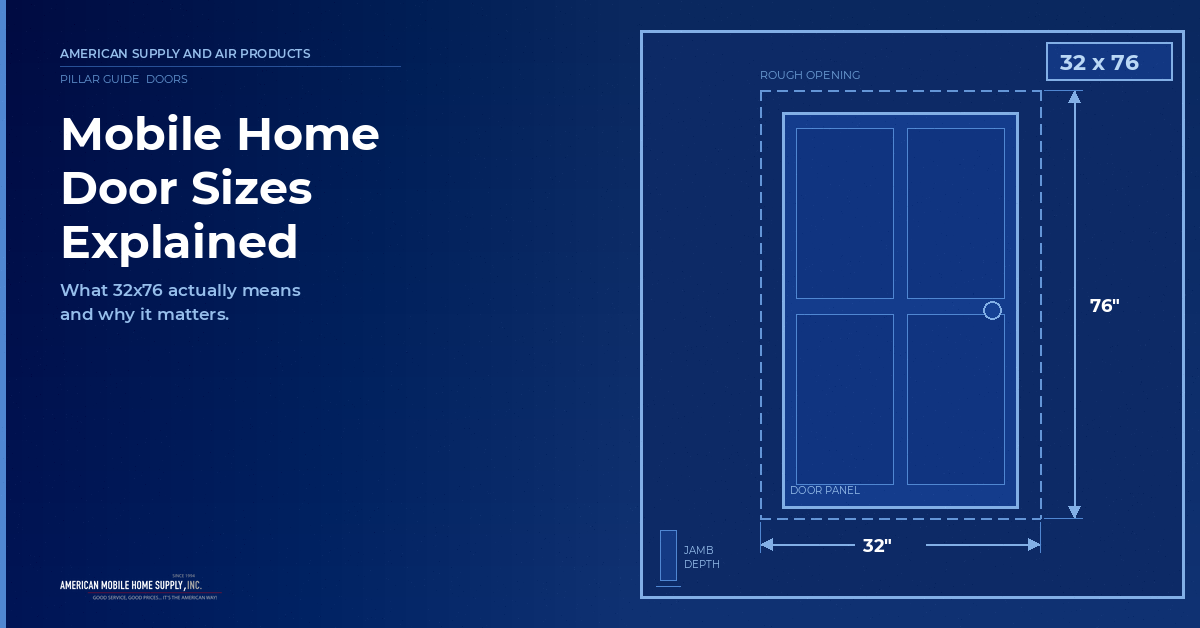
A number like 32x76 tells you almost nothing on its own. It might be referring to the bare hole cut into your wall framing. It might just be the size of the swinging door slab itself. Or it could be measuring the entire outer frame.
That is one single number trying to explain three totally different things. Mobile home door sizes work this way on purpose, and if you pick the wrong one, you end up stuck with a part you cannot return.
Mobile home doors do not follow standard house rules, which catches a lot of people by surprise. The width might look normal, but the thickness is usually completely different. Plus, the height depends heavily on when your home was built.
This guide breaks down exactly what mobile home door sizes mean, where they differ from standard residential sizing, and how to read a measurement so you order the right thing the first time.
Ordering a 32x76 mobile home door means you are looking at the width and height measured in inches. This number specifically targets the rough opening. That is just the bare, empty hole framed into your wall studs before the door frame or trim gets put in.
The swinging door slab itself runs smaller than that wall hole on purpose. You need extra wiggle room around the edges to shim the frame completely straight and get a tight weather seal. A 32-inch wall opening holds a door slab that is only 30 inches wide.
This two-inch gap catches buyers by surprise because supply websites rarely clarify which measurement they are listing. This is the rough opening vs door panel difference, and it is the single most common ordering mistake.
Quick way to tell which measurement you have: If a listing says "32x76 rough opening," that is your wall opening size. If it says "30x76 door," that is the panel size that fits inside a 32-inch rough opening. When in doubt, measure your wall opening, not your old door panel.
Reviewing standard mobile home door dimensions helps prevent installation issues. Use this mobile home door size chart to confirm the standard mobile home door size for your build before you order. These measurements apply to homes built after 1976 under modern federal housing guidelines.
| Door Configuration Type | Common Rough Opening | Common Panel Size | Thickness |
|---|---|---|---|
| Main exterior door | 32" x 76" or 34" x 76" | 30" x 74" or 32" x 74" | 1¾" (same as residential) |
| Combination door (storm + main) | 32" x 76" or 34" x 76" | Varies by storm panel style | 1¾" main panel |
| Rear/secondary exterior door | 32" x 76" | 30" x 74" | 1¾" (same as residential) |
| Interior door | 24", 28", 30", 32" wide x 78"-80" | Width minus 2" | 1⅜" (thinner than residential 1¾") |
Important: While exterior doors match the standard 1¾-inch thickness of a regular house, inside doors are much thinner. Mixing these up will completely ruin your installation, so be sure to double-check our notes on mobile home interior door thickness if you are updating your bedrooms or closets.
The Department of Housing and Urban Development enacted the federal HUD Manufactured Home Construction and Safety Standards in June 1976. Homes built in the late 1970s through around 1980 sit in a transition window, which is why many owners search by 1980 even though the code line is 1976. If your property predates 1976, do not assume your wall frames follow modern 32x76 structural guidelines.
Older trailer builders used completely custom measurements, often creating narrow 30-inch entries or short 72-inch openings.
Doors are non-returnable once installed. If your home predates 1976, measuring your existing opening before ordering is not optional. Confirm with our team if you are uncertain about your home's age or original construction specs.
To find your true rough opening dimensions, follow this targeted field checklist.
Step 1: Take off the trim. Pop off the wood or plastic molding around your current door frame. You need to see the bare wood studs hidden inside the wall.
Step 2: Measure the width. Stretch your tape measure across the opening from the left wood stud to the right wood stud. Check the distance at the top, the middle, and the bottom. Write down the smallest number you see.
Step 3: Measure the height. Measure from the floor straight up to the bottom of the top wood beam. Do this on both the left and right sides of the opening. Write down the shortest number.
Step 4: Measure the wall thickness. Check how deep the wall is from the outside siding to the inside wall paneling. This ensures your new door frame matches your wall perfectly without leaving ugly gaps.
Most buyers focus entirely on the width of a door, but the thickness of the frame is what actually makes or breaks the job.
If the new frame is too thick for your wall, it sticks out past the wall paneling. Your decorative trim will look crooked, leaving ugly gaps you cannot fix with caulk. On the other hand, if the frame is too thin, it sinks inside the wall hole, which catches the edge and stops the door from swinging open all the way.
Getting a completely flush fit depends entirely on matching the frame to your specific mobile home interior door thickness, since trailer walls are much skinnier than standard house walls.
Mobile home exterior doors and interior doors are not sized or built the same way, and mixing the two up leads to ordering mistakes.
Outside entry panels use a standard 1¾-inch thickness to shield your rooms from the weather. Sizing issues here are almost always caused by a narrow wall frame rather than the thickness of the door panel.
Inside rooms use a thinner 1⅜-inch profile. Forcing a standard house door into a trailer frame will cause the latch mechanism to bind against the casing stop.
Swing Configurations: Outswing and inswing models cannot be interchanged once the rough frame is set. Getting this wrong is a common water-leak cause, so confirm your outswing vs inswing mobile home doors setup before you order.
Swing direction does not change the rough opening dimensions, but it is the other major ordering mistake that happens alongside sizing confusion, which is why it deserves a mention here even though it is covered in full elsewhere.
If your exterior protection hardware is properly measured but still catches on your step plate, read our field manual on why your mobile home storm door won't close or latch right.
If your entryway has warped out of alignment over decades of weather exposure, the cause is usually the frame rather than the hinges, and the fix starts at the subfloor framing.
Sometimes you buy the perfect fit, but the door stops closing right after a few months. When you are looking at standard mobile home exterior door sizes, this problem usually has nothing to do with the measurements printed on the box.
When the ground moves, the wall framing gets pulled out of shape. That movement is what causes a perfectly good door to drag along the floor or refuse to click shut. Start with the simple check first. If tightening the screws and swapping worn exterior door hardware does not help, you are likely dealing with a shifting foundation, where a sagging mobile home door means the frame, not the hinges, rather than your metal hinges wearing out. Squaring the opening comes first. Once the frame sits true again, you can shop mobile home doors with confidence that the new unit will actually fit.
A combination door pairs a main exterior door with a storm panel in one unit, and the sizing logic shifts slightly because two components share one rough opening.
The rough opening dimensions stay consistent with a standard exterior door, typically 32x76 or 34x76. What changes is the depth requirement at the jamb, since the unit needs to accommodate both the main door swinging one direction and the storm panel swinging the opposite direction without either one binding against the frame.
Buyers sometimes assume a combination door requires a larger rough opening than a single door of the same width. It does not, by width or height. The difference shows up in jamb depth and in how much clearance the storm panel needs on the exterior side to swing freely, which is a detail easy to miss when comparing listings that only show width and height.
Yes. A storm door is made to match the exact same wall hole as your main outside door because they both attach to the same outer frame. The real confusion with storm doors usually happens after you hang them, not before.
A lot of mobile home owners buy the perfect size, screw it into place, and then get frustrated when the outer door refuses to click shut or lock correctly. Most of the time, this isn't a sizing mistake at all. It is just a simple mechanical issue. If your new door is rubbing or sticking against the frame, that is usually why your mobile home storm door won't close or latch right. Usually, a fast adjustment with a screwdriver solves it without forcing you to pull the whole unit back out of the wall.
Send us your rough opening measurements and we will help confirm the right fit before you order. We have supplied manufactured home parts since 1994.
Call 1-800-368-6208 | Mon-Fri 8am-5pm | Sat 9am-1pm
Keep reading on the specific problem you are dealing with:
A number like 32x76 tells you almost nothing on its own. It might be referring to the bare hole cut into your wall framing. It might just be the size of the swinging door slab itself. Or it could be measuring the entire outer frame.
That is one single number trying to explain three totally different things. Mobile home door sizes work this way on purpose, and if you pick the wrong one, you end up stuck with a part you cannot return.
Mobile home doors do not follow standard house rules, which catches a lot of people by surprise. The width might look normal, but the thickness is usually completely different. Plus, the height depends heavily on when your home was built.
This guide breaks down exactly what mobile home door sizes mean, where they differ from standard residential sizing, and how to read a measurement so you order the right thing the first time.
Ordering a 32x76 mobile home door means you are looking at the width and height measured in inches. This number specifically targets the rough opening. That is just the bare, empty hole framed into your wall studs before the door frame or trim gets put in.
The swinging door slab itself runs smaller than that wall hole on purpose. You need extra wiggle room around the edges to shim the frame completely straight and get a tight weather seal. A 32-inch wall opening holds a door slab that is only 30 inches wide.
This two-inch gap catches buyers by surprise because supply websites rarely clarify which measurement they are listing. This is the rough opening vs door panel difference, and it is the single most common ordering mistake.
Quick way to tell which measurement you have: If a listing says "32x76 rough opening," that is your wall opening size. If it says "30x76 door," that is the panel size that fits inside a 32-inch rough opening. When in doubt, measure your wall opening, not your old door panel.
Reviewing standard mobile home door dimensions helps prevent installation issues. Use this mobile home door size chart to confirm the standard mobile home door size for your build before you order. These measurements apply to homes built after 1976 under modern federal housing guidelines.
| Door Configuration Type | Common Rough Opening | Common Panel Size | Thickness |
|---|---|---|---|
| Main exterior door | 32" x 76" or 34" x 76" | 30" x 74" or 32" x 74" | 1¾" (same as residential) |
| Combination door (storm + main) | 32" x 76" or 34" x 76" | Varies by storm panel style | 1¾" main panel |
| Rear/secondary exterior door | 32" x 76" | 30" x 74" | 1¾" (same as residential) |
| Interior door | 24", 28", 30", 32" wide x 78"-80" | Width minus 2" | 1⅜" (thinner than residential 1¾") |
Important: While exterior doors match the standard 1¾-inch thickness of a regular house, inside doors are much thinner. Mixing these up will completely ruin your installation, so be sure to double-check our notes on mobile home interior door thickness if you are updating your bedrooms or closets.
The Department of Housing and Urban Development enacted the federal HUD Manufactured Home Construction and Safety Standards in June 1976. Homes built in the late 1970s through around 1980 sit in a transition window, which is why many owners search by 1980 even though the code line is 1976. If your property predates 1976, do not assume your wall frames follow modern 32x76 structural guidelines.
Older trailer builders used completely custom measurements, often creating narrow 30-inch entries or short 72-inch openings.
Doors are non-returnable once installed. If your home predates 1976, measuring your existing opening before ordering is not optional. Confirm with our team if you are uncertain about your home's age or original construction specs.
To find your true rough opening dimensions, follow this targeted field checklist.
Step 1: Take off the trim. Pop off the wood or plastic molding around your current door frame. You need to see the bare wood studs hidden inside the wall.
Step 2: Measure the width. Stretch your tape measure across the opening from the left wood stud to the right wood stud. Check the distance at the top, the middle, and the bottom. Write down the smallest number you see.
Step 3: Measure the height. Measure from the floor straight up to the bottom of the top wood beam. Do this on both the left and right sides of the opening. Write down the shortest number.
Step 4: Measure the wall thickness. Check how deep the wall is from the outside siding to the inside wall paneling. This ensures your new door frame matches your wall perfectly without leaving ugly gaps.
Most buyers focus entirely on the width of a door, but the thickness of the frame is what actually makes or breaks the job.
If the new frame is too thick for your wall, it sticks out past the wall paneling. Your decorative trim will look crooked, leaving ugly gaps you cannot fix with caulk. On the other hand, if the frame is too thin, it sinks inside the wall hole, which catches the edge and stops the door from swinging open all the way.
Getting a completely flush fit depends entirely on matching the frame to your specific mobile home interior door thickness, since trailer walls are much skinnier than standard house walls.
Mobile home exterior doors and interior doors are not sized or built the same way, and mixing the two up leads to ordering mistakes.
Outside entry panels use a standard 1¾-inch thickness to shield your rooms from the weather. Sizing issues here are almost always caused by a narrow wall frame rather than the thickness of the door panel.
Inside rooms use a thinner 1⅜-inch profile. Forcing a standard house door into a trailer frame will cause the latch mechanism to bind against the casing stop.
Swing Configurations: Outswing and inswing models cannot be interchanged once the rough frame is set. Getting this wrong is a common water-leak cause, so confirm your outswing vs inswing mobile home doors setup before you order.
Swing direction does not change the rough opening dimensions, but it is the other major ordering mistake that happens alongside sizing confusion, which is why it deserves a mention here even though it is covered in full elsewhere.
If your exterior protection hardware is properly measured but still catches on your step plate, read our field manual on why your mobile home storm door won't close or latch right.
If your entryway has warped out of alignment over decades of weather exposure, the cause is usually the frame rather than the hinges, and the fix starts at the subfloor framing.
Sometimes you buy the perfect fit, but the door stops closing right after a few months. When you are looking at standard mobile home exterior door sizes, this problem usually has nothing to do with the measurements printed on the box.
When the ground moves, the wall framing gets pulled out of shape. That movement is what causes a perfectly good door to drag along the floor or refuse to click shut. Start with the simple check first. If tightening the screws and swapping worn exterior door hardware does not help, you are likely dealing with a shifting foundation, where a sagging mobile home door means the frame, not the hinges, rather than your metal hinges wearing out. Squaring the opening comes first. Once the frame sits true again, you can shop mobile home doors with confidence that the new unit will actually fit.
A combination door pairs a main exterior door with a storm panel in one unit, and the sizing logic shifts slightly because two components share one rough opening.
The rough opening dimensions stay consistent with a standard exterior door, typically 32x76 or 34x76. What changes is the depth requirement at the jamb, since the unit needs to accommodate both the main door swinging one direction and the storm panel swinging the opposite direction without either one binding against the frame.
Buyers sometimes assume a combination door requires a larger rough opening than a single door of the same width. It does not, by width or height. The difference shows up in jamb depth and in how much clearance the storm panel needs on the exterior side to swing freely, which is a detail easy to miss when comparing listings that only show width and height.
Yes. A storm door is made to match the exact same wall hole as your main outside door because they both attach to the same outer frame. The real confusion with storm doors usually happens after you hang them, not before.
A lot of mobile home owners buy the perfect size, screw it into place, and then get frustrated when the outer door refuses to click shut or lock correctly. Most of the time, this isn't a sizing mistake at all. It is just a simple mechanical issue. If your new door is rubbing or sticking against the frame, that is usually why your mobile home storm door won't close or latch right. Usually, a fast adjustment with a screwdriver solves it without forcing you to pull the whole unit back out of the wall.
Send us your rough opening measurements and we will help confirm the right fit before you order. We have supplied manufactured home parts since 1994.
Call 1-800-368-6208 | Mon-Fri 8am-5pm | Sat 9am-1pm
Keep reading on the specific problem you are dealing with:

Powered by WooCommerce Checkout On Popup Plugin from WPSuperiors
Powered by WooCommerce Checkout On Popup Plugin from WPSuperiors


