**** We are running approximately 7 to 10 business days out for processing and packaging. As always we thank you for your business and your patience. UPDATED 7/2/26 ... Dismiss
Skip to content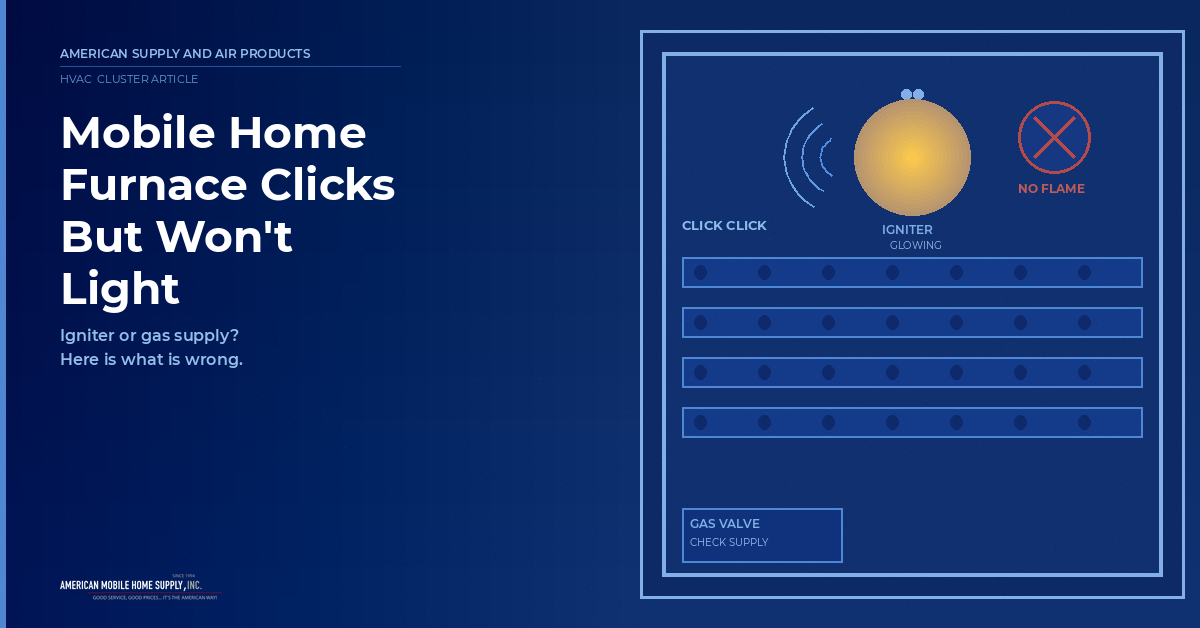
If your mobile home furnace won’t ignite, clicking with no flame means one of two things: the igniter has failed, or gas is not reaching the burner. One of those costs nothing to check. The other is a $20 to $80 part. This article tells you which one you have.
Everything here is specific to mobile home furnaces. Because authentic mobile home parts are built to specific safety and structural codes, the igniter specs, gas valve configurations, and part numbers all differ from site-built home systems.
The most inexpensive igniter we know of costs nothing. The homeowner had an empty propane tank.
Thirty seconds before touching the furnace: confirm gas is reaching it. A propane tank that reads low loses effective line pressure before it reads empty, especially in cold weather. A natural gas shutoff valve behind the furnace gets bumped in tight utility closets more often than people realize. When it is perpendicular to the pipe, gas is off.
Check whether other gas appliances in the home are working. If the stove or water heater has no gas either, the problem is upstream. Call your gas supplier, not a parts store.
Gas confirmed, and the furnace still won’t light? The igniter is next.
When dealing with a hot surface igniter, mobile home furnaces heat this part to around 2,500 degrees Fahrenheit to light the gas. It glows orange, and it fails more than any other component.
Turn the thermostat up so the furnace calls for heat. Open the front access panel and watch the igniter. A working igniter glows bright orange within 30 to 60 seconds. If it glows and no flame follows, the igniter is fine, but the gas valve is not opening. If it does not glow at all, it has failed.
Power off at the furnace switch. Disconnect the igniter leads. Set the resistance (Ohms) and probe the terminals. A working hot surface igniter reads 40 to 90 Ohms. A reading of zero indicates a short. Infinity means the element has broken, and the igniter is done.
| What You Observe | What It Means | Next Step |
|---|---|---|
| Igniter glows orange, no flame | Igniter working. Gas valve not opening. | Gas valve section below |
| Igniter does not glow | Igniter failed. | Order replacement: confirm model first |
| Igniter glows dimly or flickers | Partial failure, near end of life. | Replace now before full failure |
| Multimeter: 40 to 90 Ohms | Igniter functional. | Check gas valve or control board |
| Multimeter: 0 or infinity | Igniter failed. | Order replacement: confirm model first |
Hot surface igniters look nearly identical across brands. Same ceramic body, similar connectors, close to the same size. The resistance rating, mounting bracket dimensions, and electrical spec all vary by furnace model. An igniter from a standard residential application drops into some manufactured home furnaces and still does not heat to the temperature needed to open the gas valve. The furnace clicks, nothing lights, and the part cannot be returned.
HVAC parts cannot be returned once received, including igniters. Confirm the model number first. Order second. Full details: returns and refunds policy.
Open the front access panel. The data plate is on the inside of the door or the cabinet wall behind it. Write down both the model number and serial number. Coleman Evcon and Intertherm encode the manufacture year differently in the serial number. If the format is unclear, call 1-800-368-6208 and read both numbers to us. We confirm the exact part before you order.
Once you have your model number, you can confidently source the exact component for your brand. If your data plate points to a Coleman unit, you will need model-specific Coleman Evcon replacement parts to ensure the new igniter or gas valve integrates safely. Alternatively, if your home has a Nordyne system, you will be looking for compatible Intertherm and Miller furnace parts, which often cross-reference across different manufacturing years. We stock exact replacements for all these models going back to the 1980s and 1990s to help you avoid the trial and error of hardware store runs.
The gas valve is an electromechanical component that opens when the control board sends a signal. When it fails, gas never reaches the burner no matter how well the igniter works.
Replacing a gas valve on a mobile home furnace is a licensed technician job because it involves disconnecting live gas lines. The U.S. Department of Energy classifies this as professional service. Getting it wrong is a gas leak inside the home, not a furnace repair problem.
Before calling anyone: tell the technician the igniter glows orange, gas supply is confirmed, and no flame follows. That narrows their diagnosis before they arrive and saves a diagnostic charge.
Confirm the correct part number first. Then:
1. Power off at the furnace wall switch.
2. Close the gas shutoff valve behind the furnace.
3. Open the front access panel. The igniter is near the burner assembly.
4. Take a picture of the wiring before disconnecting.
5. Disconnect leads. Remove the two mounting screws.
6. Install the replacement. Handle it by the bracket only: skin oils on the ceramic cause premature failure.
7. Reconnect leads. Restore gas. Restore power.
8. Run a heating cycle. Igniter should glow within 60 seconds. Flame should follow within 90 seconds of the glow.
If the igniter glows but no flame follows, refer to the gas valve section above; do not attempt further DIY diagnosis on the gas side.
Hold the ceramic element by the bracket only.
Skin oils contaminate the surface and shorten the replacement’s life.
For additional installation how-to guides, visit our how-to guides section. For gas valve work, contact a licensed HVAC technician. American Supply and Air Products does not provide installation services.
Read us your model number. We confirm the exact part before you order.
Call 1-800-368-6208 | Mon-Fri 8am-5pm | Sat 9am-1pm
Browse by brand:
HVAC parts cannot be returned once received. Confirm your part number before ordering.
Testing your igniter and verifying the gas supply are the correct first steps. However, a system that still fails might be suffering from an entirely different issue. For instance, a unit that actually fires up before your mobile home furnace shuts off after a few minutes is dealing with an airflow restriction tripping the limit switch, not an ignition failure. When your symptoms don’t quite match what is covered here, step back and consult our comprehensive mobile home furnace diagnosis guide to pinpoint the exact root cause before spending money on the wrong replacement part.

Powered by WooCommerce Checkout On Popup Plugin from WPSuperiors
Powered by WooCommerce Checkout On Popup Plugin from WPSuperiors


