**** We are running approximately 7 to 10 business days out for processing and packaging. As always we thank you for your business and your patience. UPDATED 7/2/26 ... Dismiss
Skip to content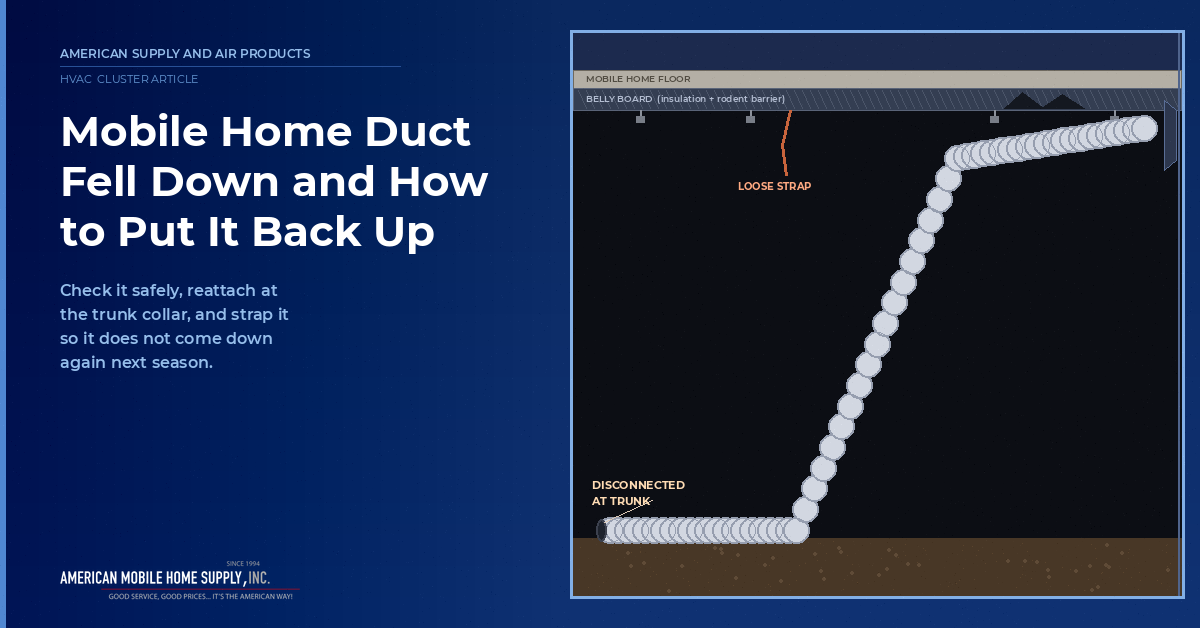
That silver pipe on the ground under your home is the duct that used to carry heat from the furnace to the far end of the house. Until it goes back where it belongs, whatever room it serves stays cold. When a mobile home duct fell down like this, or you find a duct disconnected under a mobile home in any other form, it is fixable, though the job takes more than lifting the duct back into place.
This guide walks you through what to check first, how to tell if the piece can be reattached or needs to be replaced, and how to strap it back so it does not end up on the ground again next season.
Ducts do not drop on their own. The straps holding them up are meant to last for years, and the connections at the trunk and at the boot are meant to stay put. When one lets go, find the reason before you start the repair, because whatever caused it is probably still there.
The most common chain of events runs like this. Something opens the skirting up, such as wind damage, a delivery driver, a lawnmower, or an animal digging. Air, weather, and small animals then reach the belly space. The rodent barrier inside the belly board tears. Once animals tore ductwork open at one spot, the same nest usually holds the reason a strap eventually failed. The duct is now on the ground, but the skirting is still open and the belly board is still torn.
The other common cause is age. Insulation slumps over decades, straps loosen a little at a time, and connections that were marginal at installation give way. If your home is older and the belly has been left alone, that is the more likely explanation. Either way, the broader layout of what runs where is worth reviewing before the repair. Full layout details are in mobile home ductwork problems.
Two things need attention before the physical repair starts.
If you see nesting material, prepare properly.
A duct that has been on the ground for weeks or months, especially through a warm season, may hold rodent nests. Dried droppings and old nesting material release fine particulates when disturbed, and those should not be breathed in. Wear a respirator rated for particulates, safety goggles, long sleeves, and gloves. Do not sweep the area or blow it out with compressed air. General cleanup guidance is in the CDC guidance on cleaning up after rodents. If you find damaged wiring in the belly, or the fallen section connects directly to the furnace cabinet, stop and call a licensed HVAC technician.
Not every fallen duct can go back up as it is. A quick check first saves you from reinstalling something that comes down again.
If the affected piece is the one connecting the two halves of a doublewide across the beam split, that is the crossover duct, and it has its own set of considerations, sizes, and connection requirements. Handle it as covered in mobile home crossover duct, not as a standard branch reattachment.
If water is present inside the duct or has been recently, the failure may have started with moisture rather than mechanical stress. Diagnosis for that path is in water in mobile home ducts.
Assuming the duct is intact and the failure was at a connection, the sequence to reattach a mobile home duct looks like this.
What proper strapping actually looks like
Metal plumber's strapping, sometimes called strap iron, screwed to the underside of a floor joist and wrapped under the duct so it sits in a supportive cradle. The strap should spread the weight across a wide area rather than cutting into one spot. Spacing every couple of feet is common practice, closer if the duct is long or the flex is heavy.
For replacement flex duct and metal fittings sized for manufactured home applications, our mobile home ductwork category carries the parts most commonly needed for this repair, along with the strapping and sealants that go with them.
Describe what you found under the home, the duct diameter if you can measure it, and what came loose. We can help you pull the right flex duct, collar, and strapping in one order. Measure the diameter before ordering, since the parts have to match the size already in the home. Supplying manufactured home parts since 1994.
Call 1-800-368-6208 | Mon-Fri 8am-5pm | Sat 9am-1pm
A duct sitting on the ground will fail again. Moisture wicks up from soil even on days that look dry, and the outer jacket is not made for ground contact. Rodents that have already found the space will investigate anything within reach. The duct also restricts airflow when it is pinched by uneven ground, buried under debris, or collecting moisture in a low spot. Every register past that point loses air.
Skipping the strapping step, or reusing hardware that already failed once, is why the same duct ends up on the ground twice.
Repair the skirting breach that let the weather and the animals in, patch the belly board and rodent barrier where you can, and only then treat the repair as finished. Leaving any of those undone leaves the same conditions in place.
Keep reading on the specific problem you are dealing with:

Powered by WooCommerce Checkout On Popup Plugin from WPSuperiors
Powered by WooCommerce Checkout On Popup Plugin from WPSuperiors


