**** WE ARE CURRENTLY RUNNING APPROXIMATELY 2 TO 3 WEEKS OUT FOR PROCESSING AND PACKING **PLEASE REMEMBER THAT SHIPPING TIMES YOU ARE QUOTED AT CHECK OUT ARE TRANSIT TIMES ONLY (how long it should take to get to you once the carrier has picked up your package), THIS DOES NOT INCLUDE PROCESSING AND PACKAGING TIME**. As always we thank you for your business and your patience. 9/14/26 Dismiss
Skip to content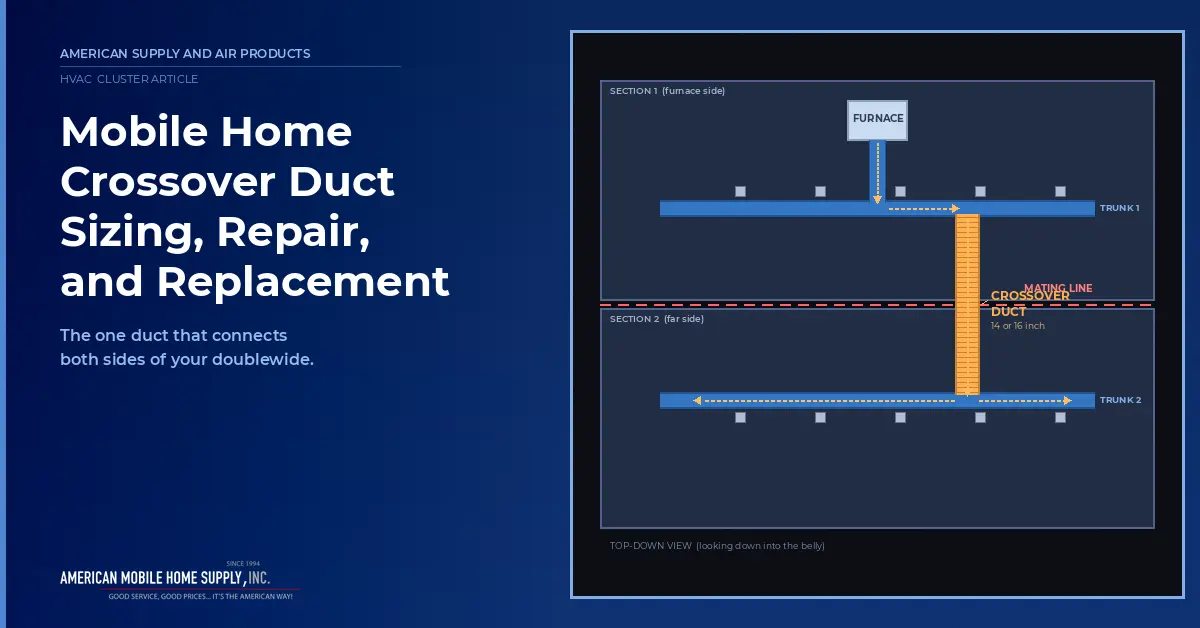
In a doublewide, you may notice one side of your home stays warm while the other side feels cold, even when the furnace is running fine. If the vents on the far side are barely moving air, the mobile home crossover duct is one of the first things to check.
The crossover is one length of insulated flex duct that runs across the middle of your home. It carries warm air from the furnace side to the other side. When it disconnects, gets crushed, or ends up on the ground, the far half of your home stops getting heat.
This guide covers what the crossover does, how to tell if it is the problem, and how to replace or reposition it correctly.
A doublewide arrives at your lot as two sections. Once they are joined, the furnace ends up on one side of the home. The ductwork on that side connects directly to the furnace. The way doublewides are built and joined follows federal standards set through the HUD Manufactured Housing program.
The other side of the doublewide has its own trunk duct running the length of that half. But it is not connected to the furnace on its own. The crossover fills that gap. It runs from the furnace-side trunk, across the middle of the home, and connects to the trunk on the other side.
Most crossovers are 14 or 16 inches in diameter, and they come pre-insulated to keep heat from escaping over the length of the run. The crossover is one of several places where mobile home ductwork problems can develop.
The clearest sign of doublewide one side no heat is a difference in airflow between the two sides of your home. When one side of a doublewide has weak or no airflow while the other side stays warm, the crossover is one of the first components to check. A disconnected, crushed, or sagging crossover can affect airflow to the far half of the home.
Sometimes the far side is not fully dead. The vents move some air, just less than they should. That can happen when the crossover has sagged, pinched against the ground, or has extra length pooling in a low spot.
A few patterns look similar but usually mean something else:
Crossovers can go wrong in a few different ways. Each one produces a slightly different symptom.
Both ends of the crossover are clamped to a trunk duct and sealed with a product called mastic. Over years of use, those connections can loosen. Animals moving through the belly space can also pull at them. Once the connection loosens enough, the crossover can pop off entirely at one end. When that happens, the far side of the home stops receiving air almost immediately.
A double wide crossover collapsed onto the ground is a common failure that can restrict airflow. If the straps holding the crossover up have failed, or if extra length was left slack at installation, the crossover can end up resting on the ground. Ground contact pinches the duct and cuts down airflow. It also lets in moisture and gives animals a way in. If your crossover has fallen and needs to be strapped back up, the reattachment steps are the same as any other fallen section.
A crossover that sags into a low point can collect water. This blocks airflow and damages the insulation. Some owners have drilled a small hole to drain the water as a temporary fix, but the real answer is repositioning or replacing the crossover so it is not sitting in a low spot anymore.
Something falling on the crossover, an animal pushing against it, or heavy insulation slumping down can crush it enough to reduce airflow without fully detaching it. If a section of the crossover looks visibly narrower than the rest, that could be why the far side is weak.
Give us a call with the length of your doublewide and the diameter of the existing crossover if you can see it. We can help you pick the right insulated flex duct before you order. We have supplied manufactured home parts since 1994.
Call 1-800-368-6208 | Mon-Fri 8am-5pm | Sat 9am-1pm
Crossover duct replacement is not complicated, but a few details make the difference between a fix that lasts and one that fails within a season.
Measure the existing crossover before ordering. Many mobile home crossovers use 14- or 16-inch duct, but measure the existing crossover before ordering rather than assuming the size. Stick with the same crossover duct size unless there is a reason to change it. Bigger is not always better with flex duct, because oversized ducts can slow the air down. Insulated flex in both common crossover sizes, along with the clamps and strapping, is stocked in our mobile home ductwork category.
Extra length is a common cause of sagging later on. Cut the new crossover just long enough to reach both connections with a small amount of slack. Do not leave a foot of extra material dangling.
Use metal plumber's strapping every few feet along the crossover, screwed into floor joists on both sides of the middle beam. If the original install used only a few straps, add more this time. Without enough support, a new crossover will sag over time just like the old one.
After clamping the connections at each trunk, apply mastic over the joints. Mastic lasts far longer than foil tape and stops warm air from escaping at the connections. Any air lost there goes into the belly cavity instead of reaching the far side of your home.
The crossover should connect to the furnace-side trunk at a point directly under the furnace. If the connection is off-center, air has to travel through part of the trunk before entering the crossover. That reduces pressure and temperature by the time the air reaches the far side.
You can check the position from inside your home instead of crawling under it. Take the blower panel off the furnace and look down into the plenum. From there, you can see where the crossover connects.
Turn off the breaker to the furnace first.
Turning the thermostat off is not enough. Someone else in the home could raise the setting without knowing you are working on the unit. Cutting power at the breaker eliminates that risk. Do this before removing the blower panel.
If the crossover connects to the trunk in the wrong spot, and your doublewide has had weak far-side airflow for years, moving the connection during a replacement is worth the extra effort. Installing a new crossover in the same wrong spot gives you the same weak airflow you had before.
Keep reading on related duct topics:

Powered by WooCommerce Checkout On Popup Plugin from WPSuperiors
Powered by WooCommerce Checkout On Popup Plugin from WPSuperiors


