**** WE ARE CURRENTLY RUNNING APPROXIMATELY 2 TO 3 WEEKS OUT FOR PROCESSING AND PACKING **PLEASE REMEMBER THAT SHIPPING TIMES YOU ARE QUOTED AT CHECK OUT ARE TRANSIT TIMES ONLY (how long it should take to get to you once the carrier has picked up your package), THIS DOES NOT INCLUDE PROCESSING AND PACKAGING TIME**. As always we thank you for your business and your patience. 9/14/26 Dismiss
Skip to content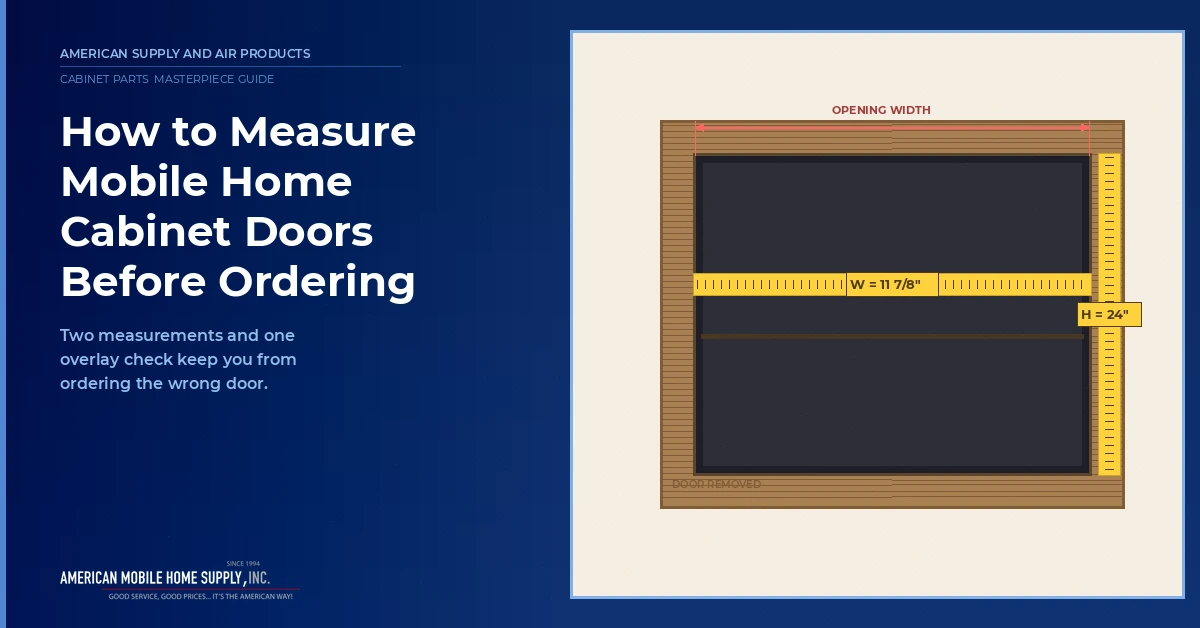
Ordering the wrong size cabinet door usually costs you two things. First, the money spent on a door that most suppliers will not take back once it has been cut for your order. Second, another week or two waiting for the right one to arrive while your kitchen sits with a missing door and everything inside on the counter.
Both problems come down to the same thing. Knowing how to measure mobile home cabinet doors before you place the order decides whether you get the right piece the first time or start over.
This guide walks through the two measurements every supplier will ask for, explains overlay in plain language, and covers the older-cabinet situations that catch a lot of people out. Bring a tape measure and a notepad. That is all you need for the whole process.
A single wrong door on a mobile home cabinet is not the end of the world, but the numbers add up fast if you are replacing more than one.
The whole thing is avoidable with about fifteen minutes of careful measuring before you touch an order form. That is what this guide is set up to help you do.
Here is the key thing that most measuring guides skip over. Different suppliers order doors differently.
Some ask you for the opening size, which is the actual hole in the front of your cabinet where the door goes. They add the overlay themselves and produce a door that fits. Other suppliers ask you for the finished door size, meaning the actual dimensions of the door itself, including overlay. Either way, you need both numbers written down before you call. If you only measured one, you will end up needing to measure the other anyway when they ask.
The safe move
Measure both the cabinet opening size and the existing door size. Write both sets of numbers down. Then whichever way the supplier orders, you have the answer ready.
The opening is what is left when you take the door off. It is the actual hole in the front of the cabinet box. This measurement is the one that almost never changes even if the old door has warped, so it is the more reliable of the two.
A typical measurement note looks like: opening width 11 and 7/8 inches, opening height 24 and 1/2 inches, side hinge on the left.
Now for the door itself. This assumes you still have the original door. If it is missing, the opening measurement is enough for most suppliers, and you can skip ahead to the overlay section for how they figure out door size from opening size.
Now compare. Subtract the opening width from the door width, and divide by two. That number is your overlay on each side. Do the same for height.
A door 12 and 7/8 inches wide over an opening 11 and 7/8 inches wide has one inch of overlay total, or half an inch on each side. That half-inch overlay is one of the most common patterns in mobile home cabinets, though not the only one.
Call us with the opening size, door size, thickness, and hinge location. We can pull the right replacement from our mobile home cabinet doors selection before you commit to an order. Supplying manufactured home parts since 1994.
Call 1-800-368-6208 | Mon-Fri 8am-5pm | Sat 9am-1pm
Overlay is a word that gets thrown around like everyone knows what it means, and most people do not. Here it is in plain English.
A cabinet has an opening. The door goes over that opening. Cabinet door overlay measurement is the amount that the door extends past the edge of the opening on each side. Zero overlay means the door sits flush inside the opening. Half-inch overlay means the door hangs over the opening by half an inch on every side.
Three styles cover almost every mobile home cabinet you will find:
| Overlay Style | What It Looks Like | Common In Mobile Homes |
|---|---|---|
| Partial overlay (typically 1/2 inch) | Door covers the opening plus about half an inch on each side, framing wood visible around it | Very common, especially in older cabinets |
| Full overlay | Door covers almost all of the cabinet face, framing wood barely visible | More common in newer cabinets and kitchen updates |
| Inset | Door sits flush inside the opening, framing wood visible all around the door | Less common in manufactured homes, more of a traditional style |
If you can tell which style your cabinets have just by looking, you have a head start. If not, the door-vs-opening subtraction you did in the last section tells you which category you fall into.
Anyone with a mobile home built in the 1970s or 1980s knows the cabinet doors from that era look different from what you find at a big box store today. A few situations come up often with older mobile home cabinet doors.
A lot of older mobile home cabinets have flat doors made of luan plywood, sometimes with a printed woodgrain surface. They are lightweight, plain, and almost impossible to match exactly if you want an identical replacement. The realistic options are either replacing all the doors in a set for a consistent look, or accepting that the new door will be slightly different from the surviving originals.
Older mobile home cabinets sometimes came in sizes you will not find in standard retail cabinet lines. Widths like 9 and 3/4 inches or heights that end in odd fractions turn up often enough that they are worth expecting. This is one reason working with a supplier who deals specifically in manufactured home parts rather than a general kitchen showroom saves headaches.
If your old door has been sagging or hard to close, the frame around the opening may be part of the problem, not just the door. Check the frame for any warping, split wood, or hinge holes that have been enlarged from repeated loosening. A new door on a bad frame produces the same problem in a few months. Frame repairs are a separate job, and sometimes the honest answer is a whole cabinet rather than just a door.
Doors are only half of a cabinet order. The hinges and hardware need to match the door as much as the size does, or you end up with a new door that will not hang correctly.
Related cabinet hardware, including hinges and pulls sized for manufactured home cabinets, is stocked in our cabinet parts category. Ordering the hardware with the doors saves a second shipping charge if you need both.

Powered by WooCommerce Checkout On Popup Plugin from WPSuperiors
Powered by WooCommerce Checkout On Popup Plugin from WPSuperiors


