As always we thank you for your business and your patience. Dismiss
Skip to content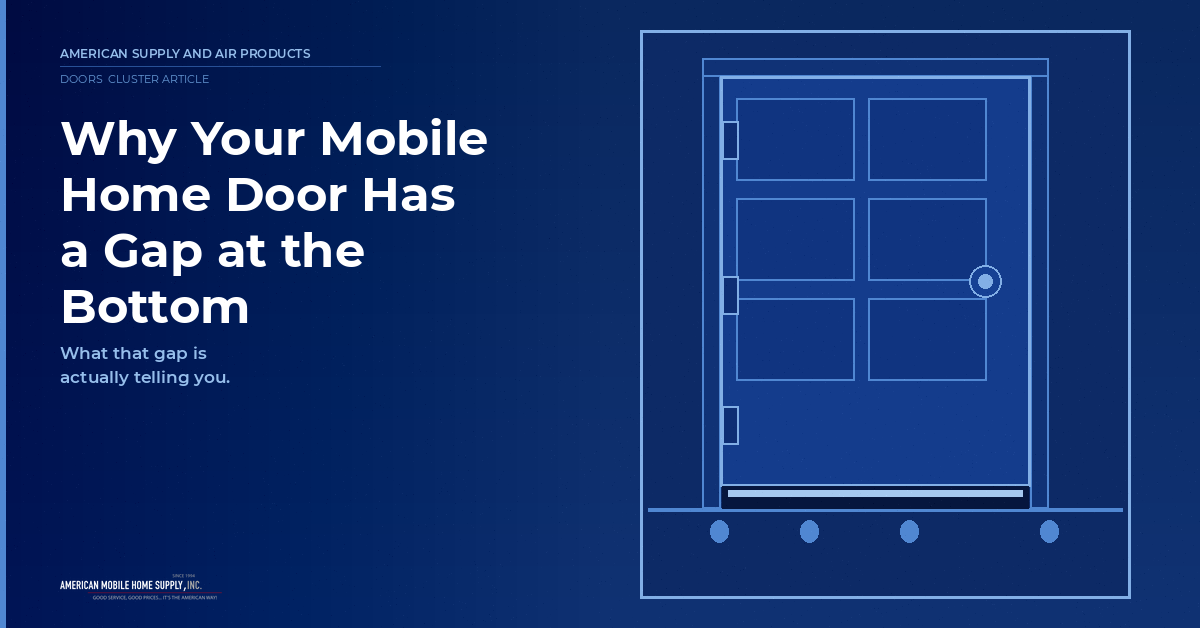
If you are dealing with a mobile home door not sealing and you can see daylight underneath it, the problem is usually one of a few things. The rubber strip at the bottom may have worn out. The door may have dropped slightly on its hinges over time. Or the home itself may have shifted enough to throw the door frame slightly out of alignment.
The difficult part is that all three problems can look almost identical when the door is closed. This guide walks through what to check first and how to tell which fix actually solves the problem.
Stand inside your home and look at the bottom of the door when it is fully closed. If you notice overlapping issues in the same room, our complete mobile home window and door problems guide will help you diagnose the rest of the hou se
Door sweeps wear out because they rub against the threshold every time the door opens and closes. After enough years, the rubber or vinyl strip compresses permanently and stops sealing.
An even gap causing a draft under the mobile home door that appeared gradually over a couple of years is almost always a worn sweep. Before pulling hinges or calling anyone about foundation work, replace the sweep. They attach to the bottom edge of the door with screws, fit without modification in most cases, and cost between $8 and $20.
“Air infiltration through gaps in doors and windows accounts for 25 to 40 percent of heating and cooling energy use in a typical home.”
For mobile homes that is especially relevant. The wall assembly is lighter and the structure sits more exposed to wind on all sides than a site-built home. The U.S. Department of Energy’s weatherization guidance specifically identifies door bottom sweeps as one of the highest-return air sealing upgrades available.
Mobile home exterior doors are heavier than the wall framing was designed to carry indefinitely. The hinge screws are threaded into the door jamb, and the jamb is a relatively thin piece of material sitting in a shallow wall cavity. Over years, the weight of the door pulls those screws slightly loose, the door drops on the latch side, and a gap opens at the bottom corner.
The repair: drive longer screws through the existing hinge plates, past the jamb and into the wall framing behind it. Standard hinge screws are short, designed for the jamb only. Replacing them with 3-inch screws that reach the structural framing redistributes the weight properly and pulls the door back to plumb.
Check all three hinges before ordering anything. A door that appears to have dropped is sometimes just the top hinge that has pulled and fixing the one hinge that has moved is enough to close the gap.
A quick way to confirm hinge failure vs frame racking: Open the door to 90 degrees and let go. A door swinging slowly toward closed on its own confirms the frame is plumb and isolates the hinges as the likely cause. A door staying exactly where you left it points to a shifted frame.
Because mobile homes sit on individual piers rather than a poured concrete slab, the entire structure naturally shifts as the ground underneath reacts to heavy rainfall, drought, and freezing temperatures When one corner of the home settles lower than the others, the entire structure twists fractionally. When the structure twists, you end up with a mobile home door frame out of square, and nearby windows usually start binding. The mobile home door gap at bottom you see is simply the door trying to sit plumb in an opening that is no longer plumb.
“The most common structural issue in manufactured housing is pier settlement, which affects door and window alignment more visibly than any other component.”
— Manufactured Housing Research Alliance
Installing a new door into a racked frame gives you a new door with the same gap. We have seen this happen to customers who spent $400 on a replacement door without having the frame assessed first. The gap came back within two months.
If the gap is unevenly wider on one side than the other, have someone check the piers before ordering any replacement door. A licensed contractor who works with mobile home foundations can adjust the pier heights and often restore the frame to plumb without any structural work on the door opening itself. The HUD manufactured housing guidelines describe the pier leveling standards that apply to manufactured homes, which is useful documentation if you are working with a contractor who is unfamiliar with this type of construction.
How to check if the frame has racked: With the door removed, measure diagonally across the rough opening from corner to corner in both directions. If those measurements differ by more than 3/8 inch, the opening is out of square enough to prevent a new door from sealing correctly.
The HUD Manufactured Home Construction and Safety Standards (24 CFR Part 3280) describe the pier leveling standards that apply — useful documentation when working with a contractor unfamiliar with manufactured home construction.
Even a door that hangs perfectly in a square frame can gap at the bottom if the threshold has worn down or shifted. Mobile home thresholds sit at the junction between the subfloor and the exterior, and they take a beating from foot traffic, water, and seasonal movement.
A threshold that has compressed, cracked, or dropped on one side creates the appearance of a door gap even when the door itself is sealing correctly against it. Run your hand along the threshold with the door closed. If you feel cold air at one specific point, the gap may be in the threshold rather than at the door sweep.
Replacement thresholds and exact-fit mobile home door weatherstripping are available through mobile home doors
Subfloor softness or water staining around the threshold warrants a closer look before applying any sealant. Water damage behind a threshold never improves on its own
Sometimes a manufactured home door gap has nothing to do with the sweep, the hinges, or the frame. The door itself has warped, the foam core has compressed unevenly, or the steel skin has dented in a way that prevents flush contact with the weatherstripping. Steel exterior doors can warp from direct sun exposure on south-facing entries, particularly on mobile homes where the door takes more direct heat than a recessed residential entry.
Signs the door needs replacing rather than adjusting:
• The door bows visibly. Hold a straight edge against the face to confirm the warp.
• The door makes contact with the weatherstripping on one side but not the other when latched
• There is water damage or rust at the bottom edge — once moisture gets into the door core, the problem accelerates; check for cold air coming from mobile window frames nearby since both entry points often fail together
• The door is the original unit from when the home was installed and has never been replaced
Mobile home back doors and front combination doors are pre-hung and ssized for standard mobile home rough openings of 32 by 76 and 34 by 76 inches. These are narrower and shorter than the 36 by 80 residential standard. A door from a hardware store does not fit without cutting into the wall framing. See mobile home back door replacement an mobile home front doors replacement for options sized to manufactured home openings.
Doors ship via LTL freight and are non-returnable once installed. Inspect the unit before the driver leaves. Any freight damage noted after the carrier departs cannot be claimed. Measure your rough opening before ordering. Full details: returns and refunds policy.
Describe what you see and we can usually narrow it down before you order anything. Our staff has been matching doors to mobile home openings since 1994.
Call 1-800-368-6208 | Mon-Fri 8am-5pm | Sat 9am-1pm
Browse door replacements:
Doors ship via freight. Processing takes 3 to 4 weeks. Inspect on delivery before signing.
Browse all mobile home parts at American Supply and Air Products, or call 1-800-368-6208.

Powered by WooCommerce Checkout On Popup Plugin from WPSuperiors
Powered by WooCommerce Checkout On Popup Plugin from WPSuperiors


