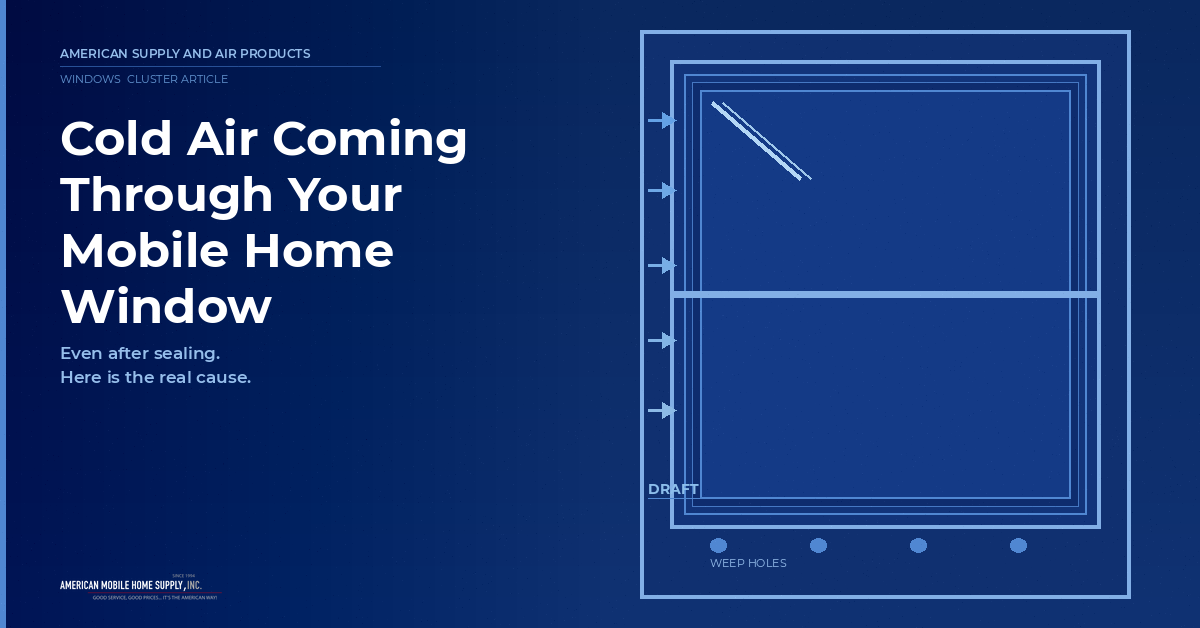
Have you ever re-caulked a mobile home window, felt good about it, and then watched the plastic sheeting you taped over it in December billow inward like a sail?
If you have cold air coming through mobile home window gaps even after sealing them, the draft is entering from somewhere else. And in mobile homes, that is often a different place than people expect. This guide helps you find it.
Is the Cold Coming Through the Window Frame or Through the Glass?
Start by putting your hand flat against the glass on a cold day. If the glass itself feels cold, what you are feeling is thermal conduction, meaning the glass is pulling the temperature of the outside air into the room. That is a different problem from air actually leaking through a gap and no amount of weatherstripping or caulk changes it.
Now run your hand slowly around the edges of the frame where the window meets the wall. If the movement is too faint to feel clearly, hold a lit lighter near the frame. If the flame pulls sideways, air is moving through. Moving air means infiltration through a gap in the mobile home window seal
The reason it matters: we see mobile home owners buy sealant and spend an afternoon re-caulking a draft around mobile home window frames when what they actually needed was a storm window over the glass.
| What You Feel |
What Is Happening |
Where to Look Next |
| Cold radiating off the glass itself |
Thermal conduction through single-pane glass |
Storm window over the existing frame, or full replacement |
| Moving air at frame edges |
Air infiltration through a gap in the seal |
Weatherstripping, exterior caulk, interior side of frame |
| Cold air behind the interior trim |
Frame separation from wall sheathing |
Remove trim, check frame flange, apply putty tape |
| Cold in one corner only |
Localized caulk failure or a crack |
Spot re-seal that corner inside and out |
Why Does the Caulk Fix It for a Season and Then the Draft Comes Back?
Mobile homes expand and contract more than site-built homes because the wall assembly is lighter and the whole structure sits on piers rather than a slab. Every winter and summer cycle moves the frame slightly. Standard latex or acrylic caulk does not always keep up with that movement and starts cracking within a year or two.
Silicone-based caulk stays flexible through temperature swings and holds up considerably better on mobile home frames. In older homes, we often see the same window re-caulked three or four times with the same latex product, each time buying one season of relief. Switching to silicone is usually what actually stops the cycle. Apply it above 40 degrees Fahrenheit so it cures before the cold hits.
Something that gets missed more often than it should: the interior side of the frame. Most people only seal from outside. In a mobile home with a wall depth of 3 to 3.5 inches, cold air that gets past the exterior caulk has a short path to the room. Sealing both sides traps it in the wall cavity.
The Weep Hole Mistake That Causes Rot
At the bottom exterior edge of most mobile home window frames, there are small drainage holes. They are there to let moisture drain out of the track. A lot of people caulk them shut when they are sealing the frame, which stops the draft for one season and causes a rot problem over the next ten years.
Leave them open. If you have a
mobile home window leaking air through the weep holes specifically, weep hole covers snap into the opening and let water drain while blocking the wind. They cost almost nothing and are available through
window parts and accessories. Sealing the holes shut is never the right fix.
What If the Caulk and Weatherstripping Are Fine and There Is Still a Draft?
On homes that are 15 to 20 years old or more, we sometimes find that the frame itself has slowly pulled away from the wall sheathing as the structure settled over time. The gap is not visible from outside because the siding covers it, and it is not visible from inside because the trim covers it. But cold air moves freely through it, bypassing the exterior seal completely.
A homeowner can spend years re-caulking the visible frame and never reach this gap. The weatherstripping seals the sash, the exterior caulk seals the outside edge, and the air still gets in because the problem is behind both of them.
How to Check
1. Pull the interior trim off around the window. Finishing nails hold it in place and it usually comes off cleanly.
2. Look at the gap between the window frame flange and the wall material behind it. Daylight or moving cold air in that gap confirms separation.
3. Check the corners first. That is where it starts on most frames.
Putty tape, not caulk, seals this gap. Caulking over the trim from the inside does not reach the frame-to-wall gap. Press putty tape firmly along the full perimeter of the frame flange before replacing the trim. If the corners have already rotted from water getting in, the window likely needs replacing rather than re-sealing.
In cases where the frame has pulled significantly, the corners have rotted, or the window no longer closes flush against the weatherstripping, re-sealing is a short-term fix at best. For replacement options sized to mobile home rough openings, see
mobile home windows. If you are not sure whether the frame is worth saving, call
1-800-368-6208 and describe what you found.
What If the Frame Is Fine and the Glass Is Still the Problem?
When figuring out
how to insulate mobile home windows from the 80s and 90s, remember that a well-sealed aluminum frame with single-pane glass still lets cold into the room because the glass itself conducts the temperature. There is no gap. The seal is intact. The glass just has no insulation value.
Storm Windows First
For frames that are still structurally solid,
mobile home storm windows are the most cost-effective path. Inside-mount storm windows drop into the interior of the existing frame over the original window, creating a second air gap that stops the thermal transfer. A 30×54 unit runs around $90 and takes about ten minutes to install without any tools.
The sizing limitation is worth knowing upfront: storm windows come in six specific widths: 14, 18, 30, 36, 40, and 46 inches. If your opening does not match one of those widths, a storm window will not seat correctly and is not the right solution. Measure your rough opening width before ordering.
When Full Replacement Makes More Sense
If the original frame is rotted, no longer closes flush, or you have a
mobile home window foggy between the panes indicating a failed seal, a storm window covers a problem rather than solving it. Full replacement with a Low-E double-pane vinyl window offers a permanent fix that addresses the structural frame condition simultaneously. To determine exactly when a frame is beyond saving, review our complete
mobile home window and door problems guide before placing an order.
Before Ordering Anything
- Confirmed whether cold is radiating from the glass or coming through the frame as moving air
- Checked both sides of the frame for caulk failure, not just the exterior
- Confirmed weep holes are open and not caulked shut
- Pulled interior trim to check for frame separation if exterior seal looks intact
- Measured rough opening width if considering a storm window
- Assessed frame condition before ordering any replacement unit
Windows are non-returnable once shipped. Confirm your rough opening size and frame condition before ordering. Full details: returns and refunds policy.
Not sure whether your frame is worth saving?
Describe what you found and we will tell you whether repair or replacement is the better path for your situation.
Call 1-800-368-6208 | Mon-Fri 8am-5pm | Sat 9am-1pm
Windows are non-returnable once shipped. Confirm your size before ordering.
Frequently Asked Questions
Why is my mobile home window drafty only in the winter and not in the summer?
The gap is there year-round. In summer the temperature difference across the glass is smaller, so the draft blends into the general air movement in the room and you do not notice it. In January when the outside is 30 degrees and your thermostat is set to 70, the same gap that was barely noticeable becomes very obvious. Worth fixing before fall regardless of whether it seems like a cold-weather issue specifically.
Can I use standard residential products for mobile home window weatherstripping?
Sometimes it works, but the track profile in mobile home windows is often narrower than what standard residential weatherstripping is designed for. If the strip does not seat properly in the track, it compresses unevenly and leaves gaps, which is worse than not re-doing it at all. Pile seal cut for mobile home window track widths is available through our
window parts and accessories and fits without modification.
Does the direction my window faces make a difference?
North-facing and northwest-facing windows get the worst of it in most of the Southeast. If one window in the house is noticeably worse than the others in winter, orientation is often part of why. In coastal North Carolina the offshore winds add to this. Worth addressing that one first and seeing how much of the overall problem it accounts for before treating every window in the home.
I replaced the weatherstripping and the draft barely changed. Why?
Nine times out of ten it is frame separation. The weatherstripping seals the sash-to-frame contact, but if the frame itself has separated from the wall sheathing, air bypasses that seal completely by entering through the gap behind the interior trim. Severe frame separation will eventually pull the frame out of square, leading to a
mobile home window issues related t lock broken situation.